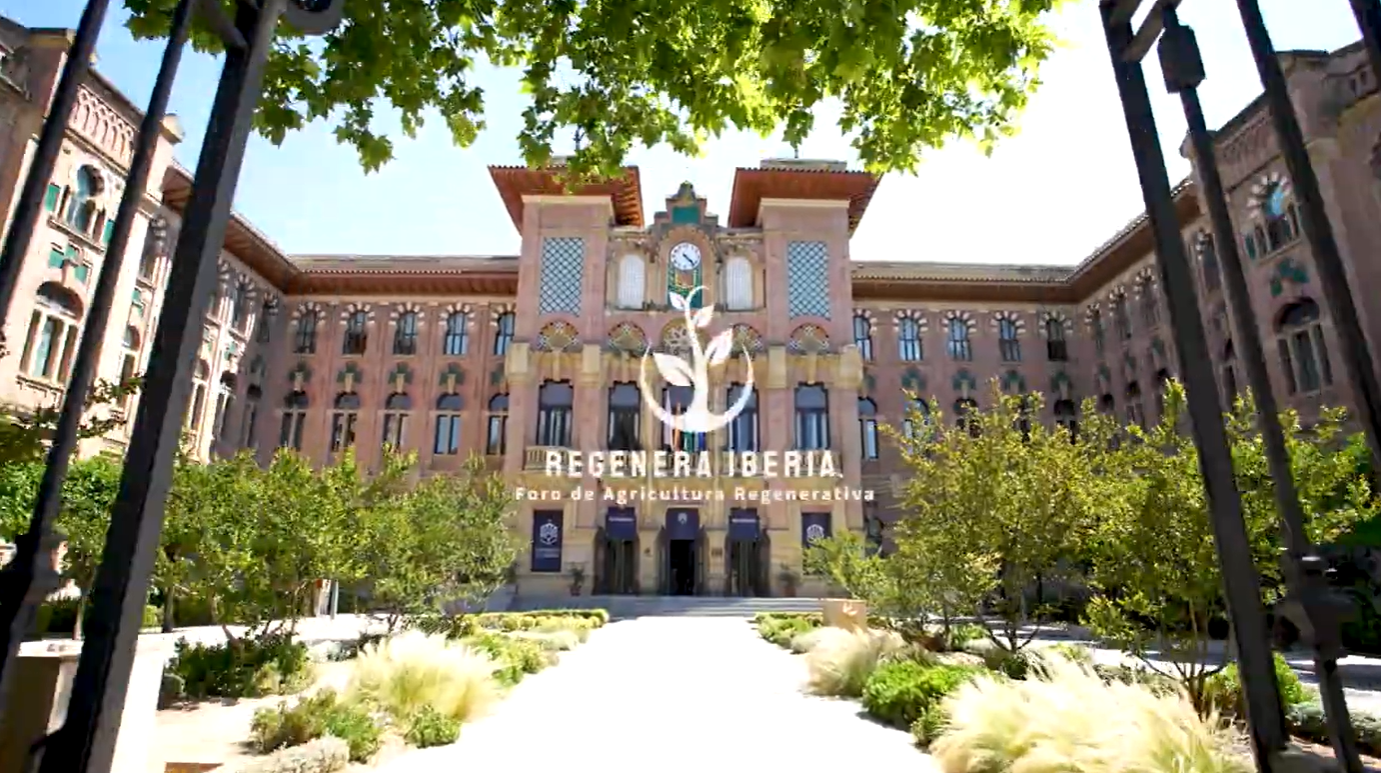
On June 9 and 10, the University of Córdoba (ETSIAM) and El Cortijo La Reina hosted REGENERA IBERIA 2026, the leading technical forum on regenerative agriculture for Spain and Portugal. Organized by ETSIAM-UCO, ZERYA® (as technical coordinator) and Agromarketing (communications), the event brought together professionals from across the entire agri-food chain—producers, procurement specialists, sustainability managers, researchers, and government officials—for more than 15 presentations featuring field data.
The common thread was the same across all five sections: regenerative practices exist, have been proven, and yield measurable results, but the market now demands that this be demonstrated with auditable data. And that’s where ZERYARegenerativa® certification comes in, which we’ll discuss at the end of this article.
The CAP Roadmap for 2028–2035: The New Framework Ahead
Tomas Garcia Azcarate (CEIGRAM-UPM) offered a critical assessment of the future CAP for 2028–2035: its “green” framework, linked to the European Green Deal, proved to be overly prescriptive and sparked resistance rather than accelerating the transition.
In light of this, he advocated for a gradual and cost-effective transition—we cannot achieve “green” agriculture “in the red”—supported by accessible technology that reduces inputs, and called on the scientific community to work alongside farmers and earn their genuine support.
Block 1 · Soil, Fertility, and Plant Health
Yara Iberian, represented by Juan José Garcia Moreno, opened with a comparative study of fertilization strategies (base, topdressing, and foliar) that measured their effects on climate, resource use, soil health, and productivity.
On behalf of the Herogra Group, Manuel Martin Andres described soil as a system of combinatorial complexity, structured around four pillars: mineral balance (Ca/Mg/K ratios according to the Albrecht method), organic matter and humic substances, the rhizosphere and its microbiology, and the plant as the element that provides feedback to the entire system. His practical message: the rhizosphere is the most accessible entry point for beginning to restore degraded soil.
André Antunes, an independent consultant, emphasized that there are no one-size-fits-all solutions: each farm requires its own assessment through soil and sap analysis (using the Albrecht, Haney, and Solvita methods, as well as enzymatic activity tests such as β-glucosidase), and an improvement plan tailored to its starting point, its crops, and its investment capacity.
Marcos Alajarín of the Fertiberia Group concluded the session with his proposal for root biostimulation aimed at improving soil health. He included the Neoforce line among the solutions available for the regeneration of mycorrhizae and soils.
Block 2 · Climate Change and Resilient Farms
Marta Muñoz of Agronova Biotech presented her trial on citrus trees (Clementine mandarin, Bétera-Valencia, 10 ha) using a biofertilizer based on Azospirillum brasilense and Pantoea dispersa (“Bulhnova”). The treated plots showed higher enzymatic activity (β-glucosidase) and greater availability of micronutrients (Fe, Zn, Mn) than the control, without altering structural parameters such as pH or CaCO₃. They demonstrated that soil regeneration must be measured, not merely claimed.
ZERYA, through its founder Antonio Alcázar, explained the zero-waste production system: what factors influence the degradation of a formulation, what the main sources of contamination are, and what criteria a product must meet to be compatible with the ZERYA Zero Pesticide Residues program.
Juan Manuel Martín of the University of Granada presented Hidroinfiltrador, a biochar device connected to the root system that promotes water infiltration and storage at depth. In a rain-fed olive grove in Bailén (Jaén), the installation of 350 units was associated with a yield increase of up to +423% between 2017 and 2024.
UPL Iberia, represented by Irene González Costa, concluded the session with its ProNutiva/GoActiv® strategy, which combines conventional protection and biosolutions. In trials on tomatoes, peppers, lettuce, and apple trees, control of botrytis, powdery mildew, and cladosporiosis was equal to or better than the standard chemical program, with higher yields and, in tomatoes, no detectable residues at the end of the growing cycle.
Block 3 · Biodiversity Conservation and Restoration
The Global Nature Foundation, in collaboration with Carlos Nuévalos, addressed one of the major outstanding challenges: how to measure biodiversity in agricultural landscapes using a common framework (percentage increase in abundance, richness, and ecological value), applied to cases such as a 250-hectare dehesa in Extremadura and cereal production by farmers in Spain and Portugal.
The SIPCAM-UCO Chair, represented by Francisco Márquez of ETSIAM, presented CropBalance®, its biostimulation and soil recovery program.
José Eugenio Gutiérrez Ureña, Director of the LIFE Olivares Vivos project / Campos Vivos (SEO/BirdLife), presented the most well-established case: increases in species richness and abundance ranging from 7% to 18% in just three years (up to 35% in the long term), at a cost of less than 4% of production costs over 10 years, backed by more than 25 scientific articles and more than 70 demonstration farms.
TRAIL4SOIL Keynote
Gottlieb Basch presented TRAILS4SOIL, a Horizon Europe project that is rolling out five Living Labs across Europe (Spain/Portugal, Austria/Switzerland, Germany, Moldova/Romania/Ukraine, and Slovenia) to co-create soil health solutions tailored to different climates and farming systems—from Mediterranean fruit trees to integrated crop-livestock systems—collectively covering about 100 experimental sites.
Block 4 · Digitalization and Resource Circularity
Food4Sustainability CoLAB, represented by David Luis, demonstrated how digital biomass data—captured by a drone equipped with RGB, NDVI, NDRE, and LiDAR sensors at a height of 20 m and a resolution of 0.86 cm/px—enables predictive models for variable-rate fertilization, differentiated irrigation, and localized treatments. In a trial with Portuguese cabbage (Brassica oleracea), treatment with a biostimulant (BioCOR) resulted in a 49.6% increase in biomass compared to the control.
Next up was the European Initiatives Office (GIESA), with Sebastien Guery presenting HIDRIX, an autonomous irrigation system developed as part of the LIFE4DOÑANA project, which combines a predictive model (IRRISTRAT) with field sensors (UNIVERSE) to determine when to irrigate, reducing water runoff to 20–25% compared to standard programming. Its relevance to regenerative agriculture is direct: when applying unmineralized organic matter, controlling nutrient leaching is key to maintaining efficacy and preventing aquifer contamination.
Esther Arias Alvarez of the University of Zaragoza concluded her presentation by highlighting the value of plant byproducts (peels, seeds, and pruning waste) as functional ingredients and antioxidants, in a context where 1,050 metric tons of food were wasted in 2022 and Law 1/2025 sets targets of a 50% reduction in retail and a 20% reduction in production by 2030.
Block 5 · Revitalization of Rural Societies
Esther Torremocha of the Daniel and Nina Carasso Foundation discussed the need for new professional profiles to bridge the culture, food, and agriculture sectors.
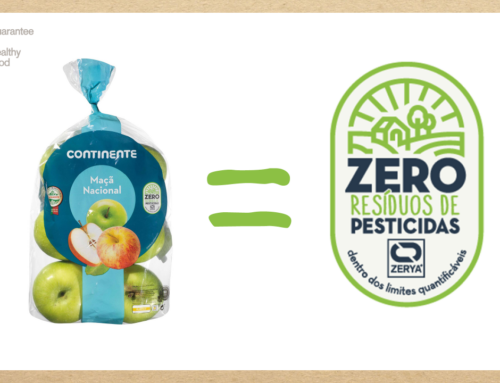
Continente Producers’ Club / MC Sonae presented the progress of the ZERYARegenerativa program for fruits and vegetables, which will involve 20 producers and 2,300 ha by 2025/26. The results showed an average 55% reduction in the use of pesticides, a general increase in soil organic matter, and a shift toward greater use of organic fertilizers over mineral ones. The Continente supermarket model encapsulates this fundamental shift: shoppers no longer ask whether a product is sustainable, but rather what metrics and certifications support that claim.
The LIFE Innocereal project, led by Francisco Márquez, wrapped up the session on collaborative projects aimed at adding economic value to the agricultural transition. Innocereal seeks to connect the entire grain supply chain through sustainable and digital agricultural best practices, reducing the carbon footprint and developing a sustainability certification for bread, pasta, and beer. Its key indicators are soil improvement, emissions reduction, and increased carbon sequestration.
The Field Trip to El Cortijo La Reina
Following the presentations at the University of Córdoba’s administration building, the second day of the Forum took attendees to Cortijo La Reina to see firsthand how the farm applies its best practices on its plots. The tour began with a presentation of the Cortijo by Juan José Herrero, the technical director, before heading down to the lower area along the Guadalquivir River, where almond and pistachio groves are located, and continued along the Almodóvar road through fields of wheat, potatoes, and onions.
The tour also included a plot of almond trees managed with organic matter, a stop at the lookout point next to the irrigation pond, the recently installed agrivoltaic system, and the organic vegetable garden, where practical examples of tomato cultivation and weed control were demonstrated. The tour continued with a stop at a high-density corn field planted on rapeseed stubble and rotated with peas, thus concluding a tour that combined field crops, woody crops, and vegetable crops.
ZERYARegenerativa®: The Link Between Regenerative Practices and the Market
The common thread among the five roundtables was clear: there are technical solutions for soil, water, biodiversity, and plant health, but their market value depends on being able to demonstrate them with verified data. The ZERYARegenerativa® certification is designed precisely for this purpose. The methodology begins with an assessment of each farm, accompanied by an improvement plan. Compliance is validated through annual audits covering four key areas: soil, climate, biodiversity, and food waste reduction.
The case of the Continente supermarkets, presented in Section 5, is in practice an example of this approach in action: a 55% reduction in the use of pesticides and an increase in organic matter, measured year over year against their own baseline. For producers, this translates into genuine differentiation and access to channels with responsible retailers; for retailers, it means a measurable and auditable framework for communicating with consumers and complying with European regulations that are moving in the same direction.
For more information on ZERYARegenerativa® certification, contact us at consultas@zerya.org and visit www.agricultura-regenerativa.com